
7 Best Crystal Furniture Suppliers for Global Buyers

Choosing among the 7 Best Crystal Furniture Suppliers for Global Buyers takes more than comparing glossy product photos. Crystal Furniture can mean a clear acrylic table, a crystal-accented cabinet, or a sculptural piece with faceted details. The materials and construction differ. So do the costs, lead times, and care requirements. A polished image cannot show a loose fitting or a vulnerable corner. Look closely.

Arts-and-Crafts designer William Morris offered a useful design test: “Have nothing in your houses that you do not know to be useful or believe to be beautiful.” For global buyers, beauty still needs practical checks. Ask suppliers about material specifications, frame strength, finish consistency, customization, minimum order quantities, and replacement parts. Request close-up photographs, written product details, and a sample when feasible. Confirm how each piece is packed, what delivery terms apply, and how damage claims are handled. Small details matter.

This guide compares suppliers through those buyer-focused questions, rather than treating sparkle as proof of quality. It is intended to help importers, retailers, and design teams build a sensible shortlist. No supplier is right for every project. A striking console may be poorly suited to a busy hotel lobby; a sturdy option may look less refined in person. That tension deserves attention. Check each supplier’s current capabilities directly, and weigh documented specifications alongside visual appeal. A little doubt is healthy.
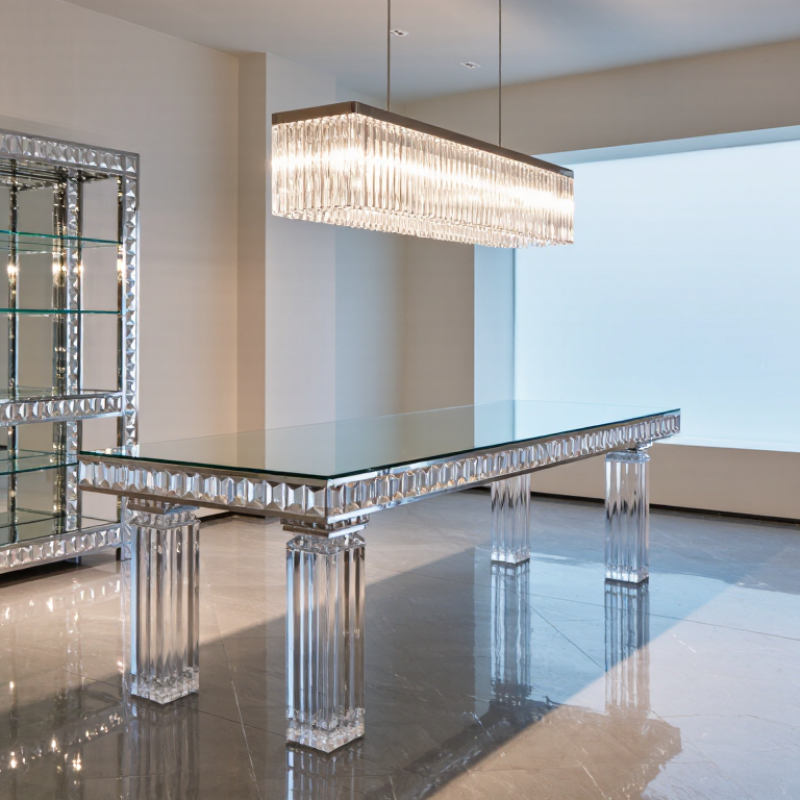
7 Best Crystal Furniture Suppliers for Global Buyers

How Crystal Furniture Suppliers Serve Global Buyers

Crystal furniture suppliers serve global buyers by turning design ideas into specifications that factories and shipping teams can follow. Buyers can share room dimensions, reference photos, and preferred finishes; suppliers can then confirm proportions, edge details, and whether a piece uses optical crystal, cut glass, or another material. These materials can look similar in photographs but differ in weight, clarity, and care requirements. Ask for a sample or close-up images before approving a large order. Small details matter.

Reliable suppliers also explain production timelines, inspection steps, packaging, and delivery options before payment. For a crystal table, that may mean checking joint alignment, polishing, and stability, then using padded inserts and a rigid crate to limit movement in transit. Clear dimensions and handling notes help buyers coordinate local delivery and installation. Not every delay is avoidable. A supplier should still communicate changes promptly and provide practical after-sales support, such as replacement-part guidance. Buyers should review drawings, packing plans, and written terms carefully; a polished catalog alone cannot confirm how a finished piece will perform.

Key Criteria for Evaluating Crystal Furniture Suppliers

A reliable crystal furniture supplier should explain exactly what “crystal” means in each product. Ask whether the piece uses cut glass, crystal components, or decorative accents, and request written specifications. Clear answers matter. Vague descriptions make comparisons difficult.

Inspect construction, not only sparkle. Check how glass panels meet metal frames, whether edges are smoothly finished, and how shelves are supported. Request close-up photos and, when practical, a sample finish. Ask for test records that match the intended use and stated load. A polished showroom image proves little. No checklist catches everything, so compare the documents with the actual sample before approving a large order.

Global buyers should also evaluate packaging, delivery planning, and communication. Ask how corners and panels are protected, what packing dimensions to expect, and how damage claims are handled. Confirm production times and spare-part availability in writing. These details can affect the final cost as much as the unit price. A supplier may answer quickly before payment, but consistent updates during production are more useful. Check references or prior project evidence where available, while remembering that every shipment has its own risks.

7 Best Crystal Furniture Suppliers for Global Buyers — Key Criteria for Evaluating Crystal Furniture Suppliers

Use this practical comparison framework to assess suppliers. “Crystal furniture” may use crystal glass, cut-glass components, or decorative crystal; confirm the exact material and product construction in writing. No supplier ranking or performance claims are implied.

Evaluation Criterion What to Check Useful Evidence to Request Buyer Evaluation Guidance
1. Material and Glass Specification Clarify whether components are crystal glass, lead-free crystal glass, ordinary glass, or another material. Check thickness, edge treatment, finish, and any coatings. Product specification sheet, material declaration, drawings, and samples that match the proposed production materials. Compare like with like. Do not treat “crystal” as a precise technical grade unless the supplier defines the material and its relevant properties.
2. Product Safety and Applicable Standards Identify the standards and legal requirements applicable to the specific furniture type and destination market. Requirements can differ for tables, shelving, seating, and glass components. Test reports for the relevant finished product or component, with the standard and edition stated; confirm the tested model matches the item being purchased. Standards such as EN 12521 for domestic tables or EN 1730 for certain table test methods may be relevant depending on the product and market. Verify applicability with a qualified testing body or compliance adviser.
3. Quality Control and Traceability Review controls for incoming materials, cutting, edge finishing, assembly, inspection, and handling of defects. Ask how production batches are identified. Written inspection plan, sample inspection records, defect-handling procedure, and batch or component traceability examples. Look for documented processes and records rather than relying only on verbal assurances or photographs of a factory.
4. Design and Customization Capability Check whether the supplier can produce the required dimensions, finishes, hardware, packaging, and branding or private-label details. Technical drawings, approved samples, finish options, tolerance information, and written confirmation of design ownership and change control. Approve a production-representative sample and signed specifications before bulk manufacture, especially for custom glass shapes or decorative details.
5. Export Packaging and Shipment Readiness Assess protection against impact, abrasion, moisture, and movement during handling and transport. Confirm carton, crate, and pallet details. Packaging specification, packing photos, drop or transit-test evidence where available, gross/net weights, and carton dimensions. Confirm packaging is suitable for the chosen transport route and that any wood packaging complies with applicable import rules, such as ISPM 15 where required.
6. Commercial Terms and Capacity Compare minimum order quantity, production schedule, payment terms, quotation validity, spare-part availability, and order-change policy. Itemized quotation, written lead-time estimate, production-capacity statement for the requested order, and agreed terms of sale. There is no universal lead time or minimum order quantity for this product category. Compare written, order-specific commitments rather than general estimates.
7. Communication, Service, and After-Sales Support Evaluate response clarity, sample coordination, installation guidance, claims handling, replacement-part support, and warranty scope. Written warranty terms, claims procedure, installation instructions, service contact details, and references that can be independently checked. Confirm who is responsible for damage, shortages, or defects, and record the agreed resolution process in the purchase contract.

Seven Notable Crystal Furniture Suppliers for International Buyers

International buyers sourcing crystal furniture should compare specialist capabilities, not just catalog images. Grand View Research valued the global furniture market at US$736.2 billion in 2023, reflecting a broad, competitive supply base. Within it, seven supplier profiles merit attention: bespoke crystal-glass workshops, precision crystal cutters, architectural glass fabricators, metal-and-glass makers, hospitality contract manufacturers, lighting-integrated furniture studios, and export-focused consolidators. Each serves different needs. A hotel project may require repeatable finishes, while a custom console may depend on careful edge polishing and exact dimensions.

Request material specifications, finish samples, load limits, and inspection records before approving production. Ask how suppliers protect corners and legs during packing; even a polished table can arrive with chipped edges. UNCTAD’s Review of Maritime Transport 2024 reports that over 80% of world merchandise trade by volume travels by sea, making packaging and transit planning essential. Confirm lead times, replacement-part availability, and who handles claims. One detail buyers sometimes overlook: crystal appearance can shift under warm showroom lighting.

Tips: Compare like with like. Specify dimensions, glass type, metal finish, packaging, and delivery terms in one quotation request. Request a sample first; photographs can hide small scratches and uneven reflections. My own judgment may be imperfect, so verify technical claims with an independent inspection when order value is high.

Material Density Reference for Crystal Furniture Buyers

Approximate density of selected materials commonly considered for decorative furniture components (g/cm³).

Density affects the weight and handling requirements of furniture components. Values are approximate reference figures; actual density varies with material composition, so request product specifications from suppliers before comparing options.

Comparing Product Ranges, Customization, and Manufacturing Capabilities

Global buyers comparing crystal furniture suppliers should examine more than catalog photos. Product ranges may span crystal-accented dining tables, console pieces, cabinets, lighting-integrated displays, and occasional furniture. Check dimensions, frame materials, edge finishing, and whether crystal elements are decorative or structural. Details matter. A broad range can simplify sourcing, but it may also hide uneven quality across product groups.

Customization is useful when room plans, hotel standards, or retail positioning differ. Ask whether suppliers can adjust dimensions, metal finishes, crystal cuts, colors, and packaging. Request a written specification before sampling. A custom option is not automatically a good one. Changes can affect stability, lead time, replacement parts, and cost. Compare a physical sample with drawings; small differences in tint or facet alignment can show under bright showroom lighting.

Manufacturing capability is best judged through evidence, not confident promises. Buyers can request production-stage photos, material declarations, inspection records, and a clear schedule for prototypes and repeat orders. Ask how the workshop protects crystal surfaces during assembly and packing. Ask for proof. In-house cutting or finishing may speed up responses, while outsourced steps can add coordination risk. Factory size alone says little about consistency. I would also check how defects are handled; some policies sound clear until a shipment arrives.

Assessing Shipping, Compliance, and After-Sales Support

A crystal furniture order depends on more than a quoted price. UNCTAD’s Review of Maritime Transport 2024 reports that maritime shipping carries over 80% of world merchandise trade by volume. Ask suppliers for realistic production and transit windows, named delivery terms, cargo insurance details, and tracking milestones. For fragile pieces, request photos of the inner cushioning, crate corners, and loading process. A tracking link alone proves little.

Compliance and support deserve equal scrutiny. The World Bank’s 2023 Logistics Performance Index assesses customs, infrastructure, international shipments, logistics competence, tracking, and timeliness. Use these areas as a checklist when comparing a supplier’s shipping process. Request product specifications, material declarations, packaging records, and export documents before payment. Requirements vary by destination, so confirm local import rules with your broker. A polished document can still leave gaps; I would check that its details match the actual order.

Tips: Get written timelines for damage claims and replacement parts. Ask who pays return freight, what photos are required, and how quickly support responds. Save the answers with your order file.