Top 10 Types of Commercial LED Outdoor Lighting

Commercial Led Outdoor Lighting does more than brighten a property after sunset. It shapes safety, visibility, identity, and operating costs. A retail entrance needs welcoming light. A warehouse yard needs consistent illumination across loading zones. A public pathway needs controlled brightness without harsh glare. These demands explain why one fixture cannot serve every commercial setting.

Lighting designer Randall Whitehead offers a useful perspective: “Lighting is the jewelry of architecture.” His words apply outdoors, where beam direction, color temperature, and fixture placement influence how buildings feel at night. However, appearance should never replace performance. Experienced professionals examine photometric data, mounting height, IP ratings, surge protection, controls, and maintenance access. They also consider nearby homes, drivers, pedestrians, and wildlife. Small oversights can create bright spots, dark corners, or unnecessary energy use.

This guide explores the top 10 types of Commercial Led Outdoor Lighting, from floodlights and wall packs to bollards, canopy fixtures, and parking lot luminaires. Each category serves a different practical purpose. Some support security. Others improve navigation or highlight architectural details. The best solution depends on site conditions, local requirements, budget, and long-term service plans. A simple ranking is impossible. There is always a compromise. A powerful fixture may increase glare, while a subtle design may leave a work area underlit. Careful planning, measured results, and honest review lead to better decisions than appearance alone.
Top 10 Types of Commercial LED Outdoor Lighting

How Commercial LED Outdoor Lighting Is Classified

Top 10 Types of Commercial LED Outdoor Lighting

Commercial LED outdoor lighting is commonly classified by location, mounting method, beam pattern, and daily purpose. Roadway lights illuminate streets, access lanes, and intersections. Parking lot lights spread wide, even light across vehicles and walking areas. Floodlights produce powerful beams for yards, façades, loading zones, and sports spaces. Area lights cover open grounds with controlled distribution. They often use poles between 20 and 40 feet high.

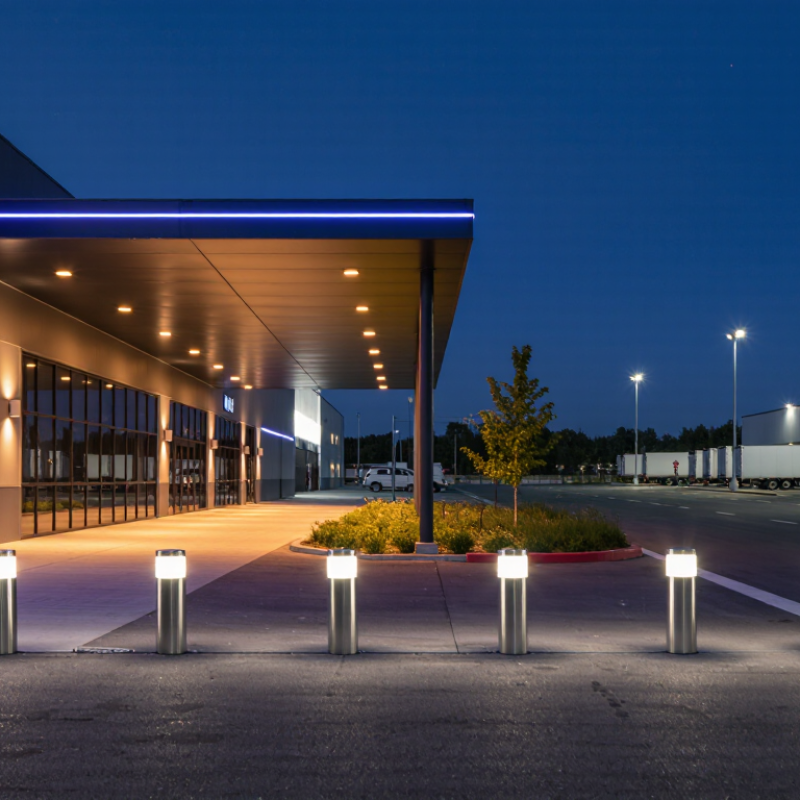
Wall pack lights mount directly on exterior walls. They support entrances, service corridors, and building perimeters. Canopy lights fit beneath gas station shelters, parking decks, and covered walkways. Bollard lights provide low-level guidance along paths and landscaping. Post-top lights combine decorative appearance with pedestrian illumination. High-mast lights serve large yards, ports, and industrial compounds. Tunnel lights are designed for changing brightness levels and limited mounting space.

These ten types are not always separated cleanly. A floodlight may support security, façade lighting, or temporary work areas. A canopy fixture can also function as a parking-deck light. Field inspection matters more than a catalog label. I check mounting height, glare, shadows, weather exposure, and maintenance access before selecting a category. IP ratings help resist dust and water, while asymmetric optics reduce wasted light near property boundaries. Controls add another layer, including photocells, timers, motion sensors, and network dimming. Poor classification remains a common mistake. The brightest fixture is not automatically the safest or most efficient choice.

Roadway and Parking Area LED Lighting Types

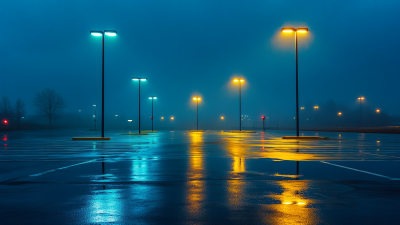
Roadway and parking areas need different LED lighting types, even when they share the same site. Roadway luminaires usually mount on straight poles or curved arms. Their precise optical patterns place light along travel lanes, reducing dark gaps between poles. Narrow roads may use forward-throw optics, while wider routes often need asymmetric distributions. Proper mounting height matters. A fixture installed too low can create harsh glare for drivers.

Parking area LED lighting includes shoebox-style fixtures, area lights, and pole-mounted floodlights. Shoebox fixtures provide broad, controlled coverage across parking rows. Floodlights can illuminate irregular corners, loading zones, or entrances. However, excessive output may brighten nearby windows and waste energy. In field projects, I have found that uniformity often matters more than maximum brightness. People notice dark spaces quickly.

Controls can improve performance. Motion sensors may reduce output during quiet hours, while photocells activate lighting at dusk. Photometric calculations should check horizontal and vertical illumination, glare, pole spacing, and emergency access routes. Local lighting codes still control the final design. This step is easy to underestimate. A computer model may look perfect, yet trees, parked trucks, or future construction can change results. Periodic nighttime inspections remain valuable, because real conditions rarely match the original plan exactly.

Flood, Area, and Security LED Lighting Types

Top 10 Types of Commercial LED Outdoor Lighting

Flood, Area, and Security LED Lighting Types

Commercial outdoor lighting works best when each fixture matches the space. Flood lights spread powerful beams across loading docks, building walls, and open yards. Area lights illuminate parking lots, walkways, and large work zones with more controlled distribution. Security lights add visibility near entrances, gates, and storage areas. Motion sensors can reduce unnecessary operation, but poor placement may create dark gaps.

The other common types include

wall packs canopy lights bollard lights pathway lights street lights parking lot lights high-bay outdoor fixtures

Wall packs mount directly to exterior walls and suit service doors. Canopy fixtures fit beneath covered parking or fuel-free loading shelters. Bollards guide pedestrians without overwhelming nearby windows. Photometric planning matters here. A bright fixture is not always a useful fixture.

In field assessments, I check

mounting height, beam angle, glare, color temperature, and nighttime shadows.

A 4,000K to 5,000K setting often supports clear visibility, though local conditions may favor warmer light. IP and impact ratings should match rain, dust, and physical exposure. Controls also need testing after installation.

I once saw a security light aimed too high, leaving the doorway dim while shining into neighboring windows. The design looked strong on paper. It still needed correction.

Regular cleaning and scheduled inspections help preserve light levels, especially near dusty roads or industrial traffic.

Wall-Mounted, Canopy, and Architectural LED Fixtures

Commercial LED outdoor lighting serves more than basic visibility. It shapes safety, comfort, and the way people understand a property after sunset. Wall-mounted fixtures work well beside entrances, service doors, and loading areas. Their placement should support facial recognition without shining directly into visitors’ eyes. I usually check mounting height, beam angle, and nearby reflective surfaces before selecting output.

Canopy LED fixtures are designed for covered parking, fuel areas, walkways, and building overhangs. They spread light across horizontal surfaces while reducing dark patches between columns. A reliable design considers ceiling height, spacing, glare control, and maintenance access. Too much brightness can feel harsh. Less can be better. In one installation, a wider beam reduced shadowing, but it also increased spill light near neighboring windows. That result needed adjustment.

Architectural LED fixtures add visual structure to façades, columns, reveals, and landscape edges. Linear grazers can emphasize texture, while compact accent lights can mark steps or entrances. The best choices match the building’s materials instead of competing with them. Color temperature matters too. Cooler light may improve crispness, but warmer light often feels more welcoming. I have found that drawings rarely reveal every nighttime problem. A site test after dark can expose glare, uneven spacing, or unexpected shadows. Weather resistance, surge protection, driver life, and accessible replacement parts also deserve careful review. No fixture is perfect. Good planning accepts that and leaves room for correction.

Top 10 Types of Commercial LED Outdoor Lighting

Representative typical luminaire efficacy by fixture type

The chart compares commonly specified commercial outdoor LED fixture categories using representative efficacy values in lumens per watt (lm/W). Actual performance varies with optics, color temperature, mounting height, controls, and lighting requirements.

Landscape, Signage, and Sports LED Lighting Types

Commercial outdoor LED lighting covers ten practical types: landscape path, bollard, in-ground, flood, wall-pack, area, parking-lot, canopy, signage, and sports lighting. Landscape designs need layered illumination. Path lights guide footsteps, while bollards define boundaries. In-ground fixtures can graze tree trunks or wash architectural surfaces. The U.S. Department of Energy reports that LEDs use at least 75% less energy and last up to 25 times longer than incandescent lighting. Real savings still depend on optics, controls, and maintenance.

Signage lighting requires visual uniformity, not simply higher brightness. Internally illuminated cabinets, channel letters, and floodlit panels need different beam patterns. The International Energy Agency estimates that lighting uses about 10% of global electricity. That figure makes efficient controls important. Photocells, occupancy sensors, and scheduled dimming can reduce unnecessary nighttime output. Check glare, spill light, color consistency, and weather protection ratings. Measure the installation after dark. Daytime approval can mislead.

Sports LED lighting demands uniform horizontal and vertical illumination. It also requires controlled glare and low flicker for broadcast cameras. IES RP-6-22 provides professional guidance for sports and recreational lighting applications. A good layout keeps players visible near sidelines, not only at center court. It also protects nearby homes from stray light. Perfect specifications rarely exist. Budget pressure changes the answer. Sometimes, a lower wattage fixture creates darker corners. Sometimes, excessive brightness creates discomfort and wasted energy. Field testing remains essential.

Top 10 Types of Commercial LED Outdoor Lighting - Landscape, Signage, and Sports LED Lighting Types
No. LED Lighting Type Typical Commercial Applications Common Color Temperature Typical Beam or Distribution Recommended Protection Common Mounting Method Primary Advantages Key Design Considerations
1 LED Floodlights Building facades, loading areas, construction sites, yards, and general outdoor security lighting. 3,000–5,000 K Wide, medium, or asymmetric distribution for broad area coverage. IP65 or higher for exposed outdoor installations. Adjustable yoke, wall bracket, or pole arm. High-output illumination, flexible aiming, and effective replacement for traditional floodlighting. Control glare, avoid spill light, and select optics according to mounting height and target area.
2 LED Area and Site Lights Parking lots, campuses, pedestrian zones, commercial plazas, and industrial sites. 3,000–4,000 K Type III, Type IV, Type V, or other asymmetric area-lighting distributions. IP65 or higher; impact-resistant housing is beneficial in public areas. Pole-top, slipfitter, tenon, or direct-arm mounting. Uniform coverage, lower energy use, and improved visibility across large properties. Photometric layout should address spacing, uniformity, pole height, and property-line light trespass.
3 LED Wall Packs Exterior walls, service entrances, warehouses, retail buildings, and perimeter security zones. 3,000–4,000 K Forward-throw, cutoff, or semi-cutoff distribution. IP65 or higher with a durable, corrosion-resistant enclosure. Surface-mounted directly to exterior walls or junction boxes. Compact installation, good doorway visibility, and effective wall-mounted security lighting. Use shielded or cutoff designs where windows, neighboring properties, or pedestrians may be affected by glare.
4 LED Street and Roadway Lights Public roads, private roads, access routes, intersections, and large residential or commercial developments. 2,700–4,000 K Roadway-specific asymmetric optics such as short, medium, or long distributions. IP66 is commonly selected for highly exposed roadway environments. Horizontal or vertical slipfitter on a roadway pole or mast arm. Improved roadway uniformity, directional control, and reduced maintenance compared with many legacy systems. Design must consider road geometry, mounting height, traffic visibility, glare limits, and local roadway standards.
5 LED Bollard Lights Walkways, parks, hotel grounds, campuses, plazas, and pedestrian entrances. 2,700–4,000 K Symmetric, asymmetric, or shielded downward distribution. IP65 or higher; impact resistance is recommended in busy pedestrian areas. Surface base or anchored ground mounting. Low-level pathway guidance, attractive appearance, and reduced upward light when properly shielded. Place bollards to maintain even spacing and avoid trip hazards, glare, and obstruction of accessible routes.
6 LED In-Ground and Well Lights Landscape uplighting, trees, columns, monuments, architectural features, and pedestrian plazas. 2,700–4,000 K Narrow spot, medium flood, or adjustable directional beam. IP67 or IP68 for recessed or ground-level locations exposed to water. Recessed in the ground or installed in a below-grade housing. Concealed appearance and precise accent lighting for landscape and architectural elements. Provide drainage, allow heat dissipation, select walk-over or drive-over ratings where required, and minimize glare.
7 LED Landscape Spotlights and Uplights Gardens, trees, sculptures, hotel landscapes, entrance features, and architectural details. 2,700–3,500 K Narrow spot to medium flood, often with adjustable aiming. IP65 or higher for exposed fixtures; IP67 may be preferred in wet or low-lying areas. Ground stake, surface base, tree mount, or concealed bracket. Flexible accent lighting, simple aiming, and effective highlighting of vertical surfaces and planting. Use shielding and careful aiming to protect views, reduce glare, and prevent unnecessary light on neighboring areas.
8 LED Sign and Billboard Lights Retail signs, monument signs, billboards, directory signs, and building identification graphics. 3,000–5,000 K Asymmetric sign-wash optics designed for even face illumination. IP65 or higher for outdoor exposure. Top-mounted, bottom-mounted, side-mounted, or sign-structure mounted. Improves sign readability while using directional light to reduce wasted illumination. Match fixture spacing and optical distribution to sign height, width, surface reflectance, and viewing distance.
9 LED Canopy and Gas-Station Lights Fueling canopies, drive-through lanes, parking garages, covered walkways, and entrance canopies. 3,500–5,000 K Wide, diffuse, or low-glare distribution for uniform horizontal illumination. IP65 or higher; impact-resistant construction is useful in high-traffic locations. Recessed, surface-mounted, or pendant-mounted beneath the canopy. Bright, uniform lighting that supports customer visibility, safety, and surveillance. Limit glare for drivers and pedestrians, coordinate with canopy structure, and consider occupancy or dimming controls.
10 LED Sports Floodlights Football and soccer fields, tennis courts, baseball fields, athletic complexes, and training facilities. 4,000–6,500 K Precision narrow, medium, or asymmetric optics for high-mast and perimeter aiming. IP66 or higher; high-impact and vibration-resistant construction is recommended. High mast, stadium tower, crossarm, or specialized sports-lighting structure. High illuminance, improved uniformity, instant start, and suitability for zoning or dimming controls. Account for required illuminance, uniformity, glare, flicker, spill light, camera compatibility, aiming, and spectator comfort.