
China Top Outdoor Garden Solar Light Suppliers
Choosing a reliable supplier can shape how an outdoor lighting project performs after sunset. An Outdoor Garden Solar Light must do more than look appealing in a product photo. It needs a suitable solar panel, a dependable battery, weather-resistant construction, and light output that matches the intended space. Small details matter.
This guide to China Top Outdoor Garden Solar Light Suppliers introduces factors buyers can examine before requesting quotes. Compare product specifications, such as battery capacity, charging time, rated protection, and operating hours. Ask how suppliers test samples and maintain consistency between production batches. Clear answers are more useful than broad promises. A neatly finished housing does not prove that a lamp will stay bright through several cloudy evenings.
Supplier selection also depends on your application. A path light, patio fixture, and decorative planter lamp may need different brightness, mounting, and runtime. Review certificates and test reports relevant to the product, and confirm what the stated warranty covers. If possible, evaluate a sample outdoors under realistic conditions. One sample cannot predict every season, and specifications may not tell the whole story. That uncertainty deserves attention. The suppliers featured in a comparison should be assessed on documented product details, communication, customization options, and after-sales support—not price alone. A careful review can narrow the field, though buyers should verify current information directly with each supplier before making a decision.
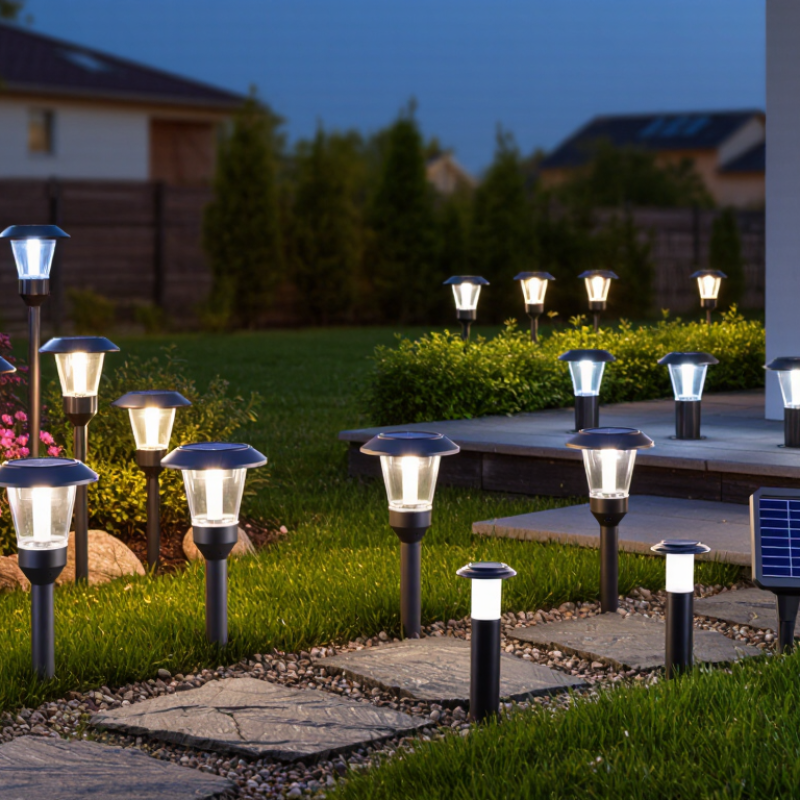
Overview of China’s Outdoor Garden Solar Light Industry
China’s outdoor garden solar-light industry sits within a much larger solar and lighting supply chain. The National Energy Administration reported 277.17 GW of new solar capacity in 2024, bringing China’s cumulative capacity to 886.66 GW. These figures describe power-generation systems, not garden-light sales. Not a direct measure. Still, they indicate the scale of China’s solar manufacturing ecosystem, which supports access to photovoltaic components, LEDs, batteries, and control electronics.
The International Energy Agency’s Renewables 2024 report projected that China would account for nearly 60% of global renewable capacity additions through 2030. That wider expansion may encourage component innovation and supplier competition, though it does not guarantee better garden lamps. Buyers and importers should check practical details: panel output, battery capacity, dusk-to-dawn runtime, ingress protection, and performance after cloudy days. A bright first night proves little. Battery aging and winter sunlight can change the result. Industry-wide data for garden-light shipments are less visible than power-sector statistics, so broad solar growth should not be mistaken for a precise measure of this product segment. That distinction matters.
| China Top Outdoor Garden Solar Light Suppliers - Overview of China’s Outdoor Garden Solar Light Industry | ||
|---|---|---|
| Industry Dimension | Overview | Buyer Considerations |
| Core Product Categories | Common products include solar pathway stakes, bollard lights, wall lights, decorative lanterns, spotlights, and garden string lights. | Match the product type to its installation location, desired light distribution, and intended use, such as pathway guidance or accent lighting. |
| Manufacturing Regions | Outdoor lighting production and supply chains are found in several coastal manufacturing areas, including parts of Guangdong, Zhejiang, Jiangsu, and Fujian. | Regional proximity to component suppliers can support product variety and sourcing flexibility; verify each supplier’s actual production capabilities. |
| Typical Product Configuration | A solar garden light commonly combines a photovoltaic panel, rechargeable battery, LED light source, control circuit, and housing. | Ask for component specifications and confirm whether the panel, battery, and light source can be serviced or replaced. |
| Solar Panel Options | Monocrystalline and polycrystalline silicon panels are used in solar lighting products. Panel size and output vary with the product design. | Compare panel ratings and charging performance under the expected sunlight conditions rather than relying on appearance alone. |
| Battery Types | Rechargeable lithium-ion and LiFePO4 batteries are used in many products; NiMH batteries are also found in some designs. | Check battery chemistry, capacity, operating temperature limits, replacement availability, and the supplier’s stated cycle-life test conditions. |
| Lighting and Controls | Products may offer dusk-to-dawn operation, selectable lighting modes, motion sensing, or adjustable brightness, depending on the model. | Request runtime and brightness information for each mode. Motion-sensor performance and detection range should be tested in the intended installation setting. |
| Weather Protection | Enclosure protection varies by design. Products intended for outdoor use may carry an IP rating, but the rating is not uniform across the category. | Confirm the exact IP rating and the test evidence for the complete assembled product, including switches, joints, and charging ports. |
| Materials and Finishes | Housings commonly use plastics, aluminum, stainless steel, glass, or combinations of these materials. Finish and construction vary by price point and application. | Assess resistance to UV exposure, corrosion, impact, and temperature changes based on the destination climate and installation environment. |
| Compliance and Testing | Market requirements depend on the destination country and product design. Buyers may encounter requests for CE or RoHS documentation for relevant markets. | Verify applicable regulations, test reports, labeling, and documentation for the specific model and destination market; do not assume all products have the same approvals. |
| Customization and OEM/ODM | Suppliers may offer choices in housing color, materials, packaging, lighting modes, and product specifications, subject to design and order requirements. | Confirm minimum order quantities, tooling needs, sample approval steps, production lead time, and ownership of custom designs before placing an order. |
| Quality Control | Production checks can include appearance inspection, charging and lighting function tests, battery checks, and water-resistance testing, depending on the supplier’s process. | Agree on inspection criteria in writing and consider pre-shipment inspection for larger orders, especially for battery performance and outdoor sealing. |
| Demand and Product Trends | Interest in cordless installation, energy-saving outdoor lighting, decorative garden products, and sensor-based controls supports a broad range of solar-light designs. | Evaluate local seasonality, sunlight conditions, consumer preferences, and applicable energy or product regulations before selecting a product assortment. |
| Note: Product specifications, certifications, manufacturing capabilities, and test results vary by supplier and model. Confirm all technical and compliance details directly for the specific product being sourced. | ||