What Is Exterior LED Lighting and What Types Are Available?

Exterior LED Lighting does more than brighten a doorway. It helps people find a path, recognize a house number, and use outdoor spaces after dusk. The right setup can also make steps, garden edges, and parking areas easier to see. Yet brighter is not always better. A poorly aimed fixture can throw glare into a neighbor’s window or leave harsh shadows across a walkway.

Lighting designer and educator James Benya has emphasized a useful principle: outdoor lighting should serve a clear visual purpose, not simply add brightness. That idea is a good starting point for understanding Exterior LED Lighting. A home may need wall lights near an entrance, low path lights along a walkway, or floodlights for a wider area. Each type has a different beam, mounting position, and job. Small details matter. A shielded fixture can direct light downward, while a warmer color temperature may feel gentler near a patio. Still, labels alone do not guarantee comfort; placement and aiming deserve a second look.

This guide explains what Exterior LED Lighting is and explores the main types available. It also considers where each fixture works best, what features to compare, and how to avoid common planning mistakes. A narrow path does not need a stadium’s worth of light. Sometimes, less works better. Lighting needs differ from one property to another, so the most practical choice begins with the space, its users, and the details that must remain visible.
What Is Exterior LED Lighting and What Types Are Available?

What Exterior LED Lighting Is: Fixtures, Optics, and Outdoor Ratings

Exterior LED lighting uses light-emitting diodes in fixtures built to withstand outdoor conditions. Common types include wall packs for building entrances, floodlights for broad coverage, and area lights for parking lots and paths. The fixture matters, but its optics matter just as much. A narrow beam can brighten a doorway without lighting the whole yard; a poorly aimed wide beam may spill onto windows or the night sky. Check photometric plans for beam spread, mounting height, and glare control. Small choices change what people see.

Outdoor ratings describe specific risks, not overall quality. Under IEC 60529, IP65 means dust-tight and protected against water jets; IP67 adds protection against temporary immersion. Neither rating confirms resistance to corrosion or impact, so check materials and impact ratings too. The U.S. Department of Energy’s 2019 Energy Savings Forecast estimated that widespread LED adoption could save about 569 terawatt-hours annually by 2035 across general illumination. That broad forecast is not an exterior-lighting guarantee. Color temperature and shielding still need attention. A bright fixture can feel harsh. One detail gets overlooked: wet locations, salt air, and wind-driven rain place different demands on a fitting. Not every site is simple.

How LEDs Use at Least 75% Less Energy, per the U.S. Department of Energy

Exterior LED lighting uses light-emitting diodes to turn electricity into visible light for porches, paths, steps, and driveways.

The U.S. Department of Energy says LEDs use at least 75% less energy than incandescent lighting. For a comparable level of brightness, an LED bulb may use about 8 to 10 watts where an incandescent bulb used 60.

Check lumens, not just watts, when comparing brightness. That matters outdoors.

Available types include porch and wall lights, pathway fixtures, step lights, and wide-beam floodlights. Some include motion sensors or timers, which can limit hours of operation.

The percentage can sound tidy; real installations are messier. Energy savings depend on brightness, nightly use, and controls, so a household’s bill may not fall by 75%. Still, check the fixture.

Outdoor lights need suitable weather protection, and an LED must fit the fixture’s requirements. Heat, moisture, and poor airflow can affect lifespan. A bright floodlight aimed at a neighbor’s window may also create glare; careful placement matters as much as the bulb.

Main Types: Floodlights, Wall Packs, Area Lights, and Path Lights

Exterior LED lighting uses light-emitting diodes to illuminate building exteriors, parking areas, walkways, and entrances. The fixture type matters: distribution, mounting height, and glare control can affect safety and energy use. A bright fixture is not automatically a better one.

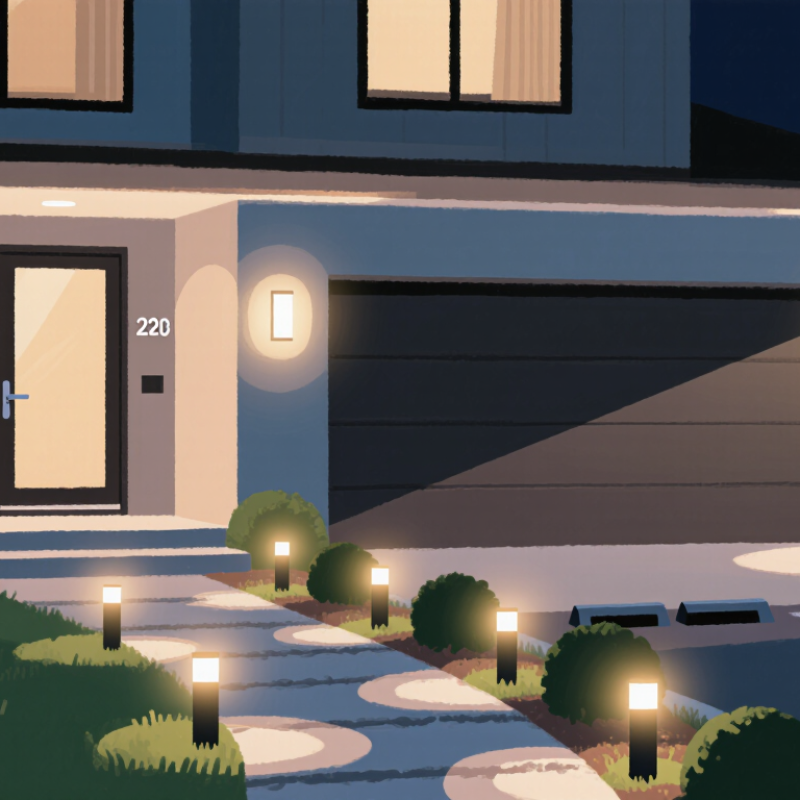
Floodlights cast broad, powerful beams onto façades, loading zones, or large yards. Aim them carefully; light spilling into windows can cause discomfort.

Wall packs mount directly to exterior walls and suit doorways, service corridors, and building perimeters. Their downward or shielded optics help keep light on the ground.

Area lights, often mounted on poles, cover parking lots and open spaces. Spacing and mounting height should be planned together to avoid dark patches.

Path lights sit low beside walkways and landscaping. They guide pedestrians, but excessive brightness can obscure edges rather than reveal them.

LED performance can make these applications more efficient, though results depend on fixture design and operating hours. The U.S. Department of Energy’s 2019 Energy Savings Forecast of Solid-State Lighting projected potential annual savings of 569 terawatt-hours by 2035 across general lighting applications—not exterior lighting alone. That distinction matters. A common planning mistake is choosing by wattage or appearance, then overlooking beam direction and uniformity. Check the site at night, too. It can reveal surprises.

Solar, Motion-Sensor, and Dusk-to-Dawn Exterior LED Options

What Is Exterior LED Lighting and What Types Are Available?
Solar, Motion-Sensor, and Dusk-to-Dawn Exterior LED Options

Exterior LED lights use light-emitting diodes to illuminate paths, entrances, patios, and other outdoor areas. Their efficiency and long service life make them a practical choice, but the control type matters just as much. Solar, motion-sensor, and dusk-to-dawn models each suit different routines.

Solar LEDs collect energy through a panel during daylight and store it for nighttime use. They can work well along a sunny walkway where adding wiring is inconvenient. Check the panel’s exposure and the light’s expected runtime; shade, winter days, and cloudy weather can reduce output. A bright lamp is not always a dependable one.

Motion-sensor lights switch on when movement is detected, which can help illuminate a doorway or driveway only when needed. Aim the sensor away from busy streets or swaying branches to reduce unwanted activation. Dusk-to-dawn models use a light sensor to turn on at evening and off at daybreak, providing steady illumination without daily switching. They are useful near entrances, though continuous operation may use more energy than motion-based lighting. It is easy to overestimate how much brightness a space needs. Start with the area’s actual use, then choose a suitable beam and placement.

How to Choose: IP Ratings, Color Temperature, and Light Output

Exterior LED lighting uses light-emitting diodes to illuminate entrances, paths, façades, and outdoor work areas. For exposed fixtures, check the IP rating under IEC 60529: the first digit indicates protection from solid particles, and the second indicates water protection. IP65 is dust-tight and protected against water jets; it is not rated for immersion. Match the rating to the fixture’s actual exposure, including wind-driven rain and sprinkler spray.

Color temperature affects how a space feels and looks. Around 2700–3000 K gives a warm, softer appearance; cooler light can make steps and work areas look crisper, but may feel harsh near a home. Compare lumen output, not watts, when judging brightness. The U.S. Department of Energy’s LED guidance reports that LEDs use at least 75% less energy and can last up to 25 times longer than incandescent lighting. Still, more lumens are not always better: glare can hide detail rather than reveal it.

Tips: Check the mounting height and beam spread before choosing output. A narrow beam may leave dark gaps along a path. Use a consistent color temperature across nearby fixtures, and review a sample at night if possible. Small differences can be surprisingly noticeable.

Exterior LED Lighting: Typical Light Output by Fixture Type

Approximate lumen examples for common outdoor applications. Actual output varies by fixture design, beam angle, and installation.

Choose output for the area and task: path lights often use fewer lumens, while area lights illuminate larger spaces. For weather protection, check the IP rating: the first digit indicates protection from solids and dust, and the second indicates protection from water. IP44 protects against splashing water; IP65 is dust-tight and protected against water jets. For color temperature, 2700–3000K gives a warm appearance, around 4000K looks neutral, and 5000K or higher appears cooler.