What Is an LED Lamp and How Does It Work?
A Led Lamp turns electrical energy into visible light through a semiconductor, not a glowing wire. Inside its small package, electric current crosses a junction between two semiconductor layers. Electrons meet positively charged “holes” and release energy as photons. The material determines the light’s color. Simple in principle.
Nick Holonyak Jr., widely recognized for developing the first practical visible-spectrum LED, described it as “the most important thing to happen to lighting since the incandescent bulb.” His remark captures the technology’s significance, but performance still depends on the whole lamp. A driver regulates incoming current, while a heat sink moves warmth away from the LED chip. Look closely at a bulb’s base: those hidden parts help keep its light steady and its components cooler.
This guide explains how LEDs produce light, how a Led Lamp differs from older bulbs, and what affects brightness, color, and energy use. It also considers labels such as lumens and color temperature, which are more useful for choosing a lamp than wattage alone. No design is perfect. Heat, dimmer compatibility, and poor-quality drivers can still cause problems. That detail deserves attention, especially when a lamp will be used for hours each day. Understanding the mechanism makes product claims easier to assess—and helps explain why two bulbs with similar shapes may perform very differently.
LED Lamp Definition: A Semiconductor Light Source, as Classified by DOE
An LED lamp is a semiconductor light source, a category used by the U.S. Department of Energy in describing solid-state lighting. Its light comes from a small semiconductor diode, not a heated filament. When electric current passes through the diode, electrons and positively charged “holes” interact and release energy as photons. That process is called electroluminescence. In practical terms, the chip turns electrical energy directly into light.
The chip is only one part of the lamp. A driver regulates the incoming current, while a heat-conducting base carries warmth away from the semiconductor. A lens or diffuser shapes the beam, helping spread light across a desk or ceiling. These parts matter. Poor heat control can shorten an LED’s useful life, even when the lamp still turns on. Color and brightness also depend on the chip and surrounding materials, so two lamps can look different despite similar labels.
LEDs are efficient, but “efficient” does not mean every watt becomes visible light. Some energy still becomes heat, and poorly designed optics can waste light in the wrong direction. I find the term “lamp” slightly confusing here: people often use it for the whole bulb, while the LED itself is just the light-producing component. Small distinction. It matters when comparing performance claims.
Electroluminescence: How Current Through a Diode Produces Light
Inside an LED, current crosses a semiconductor junction from the n-type side toward the p-type side. Electrons meet “holes,” the vacancies they can occupy, and release energy as photons. This process is electroluminescence. The semiconductor’s bandgap helps determine photon energy, and therefore the light’s color. A blue LED can produce white light when a phosphor layer converts some blue photons into broader wavelengths. Tiny junction, visible result.
The chip needs controlled current, so an LED lamp includes a driver that converts incoming power into a suitable supply. Too much current can create excess heat and shorten component life; the lamp’s housing helps carry heat away. Not every photon escapes, either. Some energy becomes heat, and the optics can absorb or redirect light. The neat textbook explanation leaves out those losses. In its LED lighting guidance, the U.S. Department of Energy reports that LEDs use at least 75% less energy and can last up to 25 times longer than incandescent lighting. Those figures describe broad comparisons, not a guarantee for every lamp or operating condition. In practice, brightness, temperature, driver quality, and ventilation all matter.
Key Components: LED Chip, Driver, Heat Sink, and Optical Lens
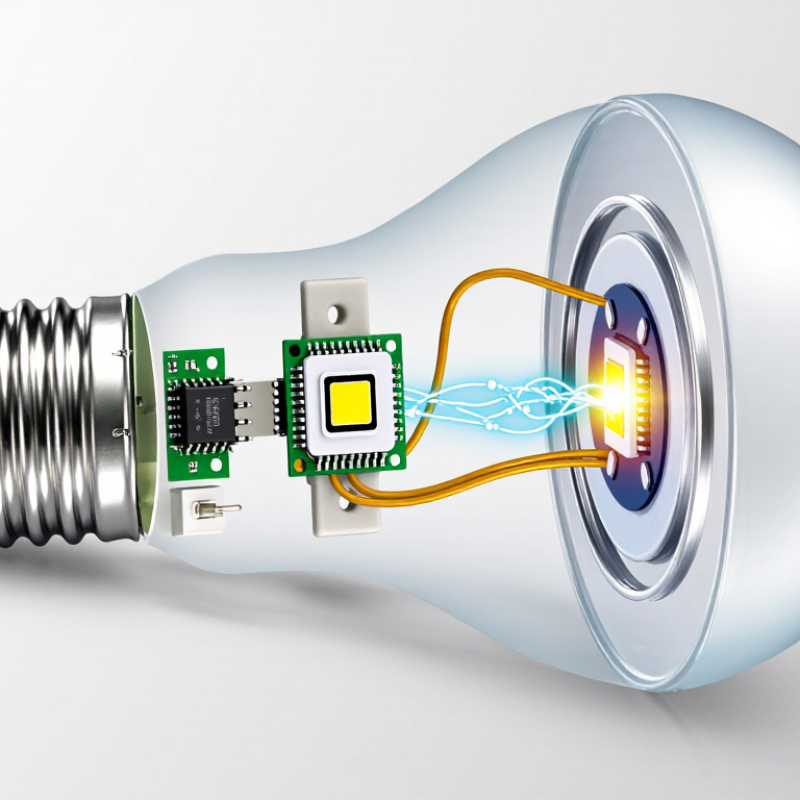
An LED lamp begins with the LED chip, where electrical energy produces light. The chip is mounted on a small circuit board, often beneath a clear or yellowish phosphor layer. In use, the light may look steady, but its color and brightness depend on the chip and the current it receives. Small changes matter.
The driver regulates the electricity flowing to the chip. It converts incoming power into a controlled output and helps limit flicker and damaging current spikes. A poorly matched driver can cause visible pulsing, buzzing, or early failure. Not every flicker is easy to notice, especially in bright rooms, so a lamp may seem fine until it is used for reading or close-up work.
Heat is another practical concern. The heat sink draws warmth away from the chip, typically through metal fins or a broad aluminum body. If heat remains trapped, light output and service life can decline. The optical lens or diffuser then shapes the light, spreading it across a desk or directing it into a narrower beam. A frosted cover can soften harsh points of light, though it may reduce brightness slightly. That trade-off is easy to overlook. These parts must work together, and compact designs sometimes leave less room for cooling than ideal.
What Is an LED Lamp and How Does It Work?
A typical phosphor-converted white LED combines blue light from an LED chip with broader-wavelength light produced by phosphor.
The chart shows approximate wavelength ranges in nanometers; the exact spectrum varies by LED design. The driver regulates current to the chip, the heat sink carries heat away, and the optical lens shapes and directs the light.
Energy and Service Life: DOE Says LEDs Use 75% Less Energy and Last Up to 25× Longer
An LED lamp produces light with a semiconductor, not a heated filament. When electricity passes through the semiconductor, it emits light while generating relatively little heat. The U.S. Department of Energy says residential LEDs use at least 75% less energy than incandescent bulbs. That difference can show up on a lamp used for hours each evening. Less wasted heat, too.
Long service life is the other part of the claim. DOE says LEDs can last up to 25 times longer than incandescent lighting. An LED rated for 15,000 hours, for example, may run for years in a hallway used a few hours daily. But “up to” matters. Actual life depends on the lamp’s design, ventilation, and use. A tightly enclosed fixture can trap heat, and frequent switching may affect some products. The headline figures are helpful, but they are not a guarantee for every room. Check the lamp’s rated life and energy use, and consider whether its brightness suits the fixture. A low-wattage lamp can still feel too dim—or oddly harsh—at a desk.
What Is an LED Lamp and How Does It Work? — Energy and Service Life
Energy-use and service-life figures are DOE general comparisons with incandescent lighting, not guarantees for every lamp. Actual performance varies with product design, usage, and operating conditions.